
South America is often cited as the “Bird Continent,” and at the very heart of this ecological marvel lies Peru. For biologists, ornithologists, and nature enthusiasts, this nation is not just a travel destination; it is a pilgrimage site. The sheer variety of Peruvian birds is staggering, with a national checklist that rivals entire continents. From the bone-dry coastal deserts to the dizzying heights of the glacial Andes, and down into the steaming, verdant expanse of the Amazon Basin, the country offers a masterclass in evolutionary adaptation.
While the ancient ruins of Machu Picchu often steal the spotlight, the skies above these monuments tell an equally compelling story. With over 1,800 recorded species, Peruvian birds represent approximately 20% of the world’s total avian population. This biological density turns every hike, boat ride, and scenic drive into a potential discovery. In this extensive guide, we will journey through the diverse ecosystems of the country to understand the lives, behaviors, and habitats of seven specific species that define the region. These are not just animals; they are the living heritage of the Inca land.
The Geographical Stage: Why Peru?
To truly appreciate the magnificence of Peruvian birds, one must first understand the stage upon which they perform. Peru is essentially a vertical country. The Andes mountain range acts as a colossal wall, separating the Pacific coast from the Amazon rainforest. This separation creates a dramatic array of microclimates.
On the western slope, the cold Humboldt Current creates a coastal desert that is surprisingly rich in marine life. As you ascend the Andes, oxygen levels drop, and temperatures plummet, creating habitats for species adapted to extreme conditions. Crossing the peaks to the eastern slope, the humidity rises, creating the “cloud forest”—a misty, moss-covered realm that eventually gives way to the lowland Amazon. This geographical complexity drives speciation, leading to the incredible diversity of Peruvian birds we see today.
Here, we explore seven iconic species that serve as ambassadors for this rich natural heritage.
1. The Andean Cock-of-the-rock (Rupicola peruvianus)
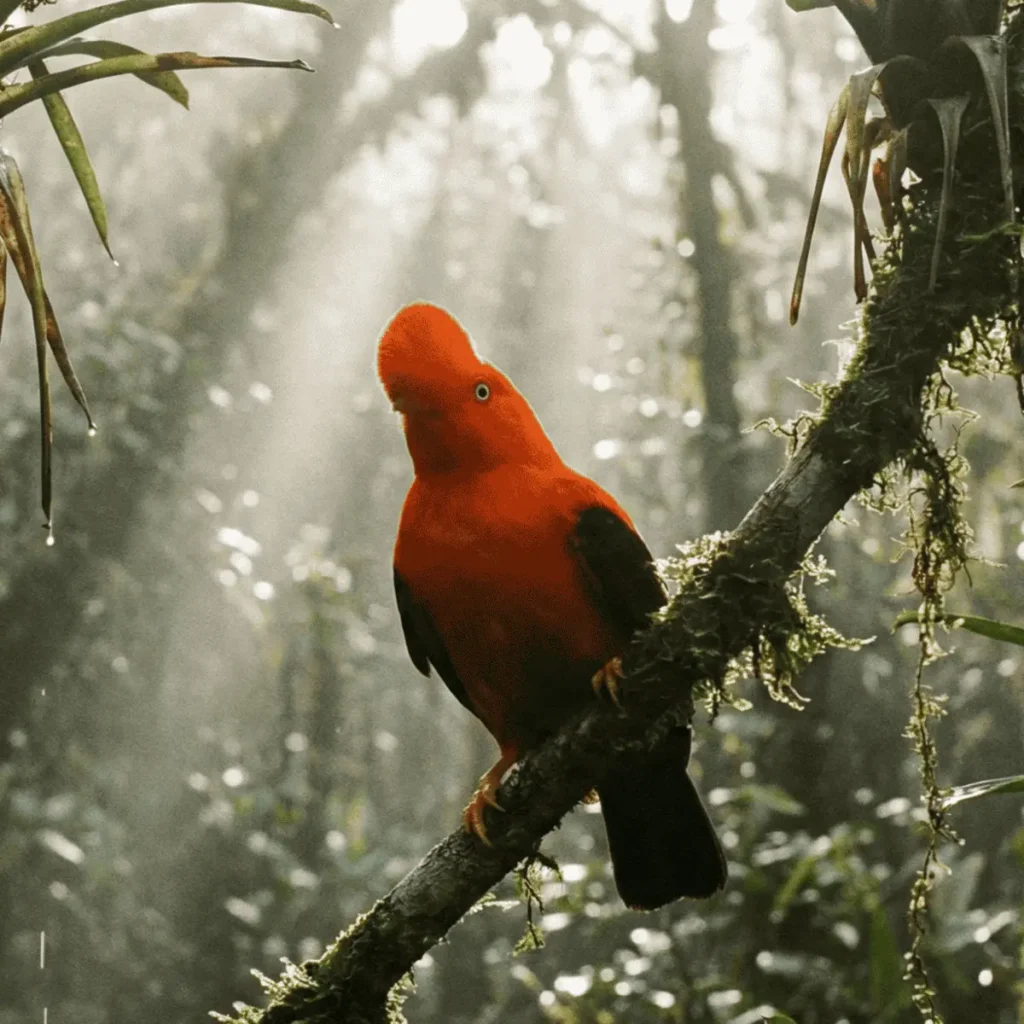
Deep in the cloud forests, where the mist clings to the trees and the vegetation is thick with bromeliads and orchids, lives a bird that defies convention. The Andean Cock-of-the-rock is the National Bird of Peru, a title it holds with flamboyant pride. Among all Peruvian birds, few possess the visual impact of the male Cock-of-the-rock.
A Masterpiece of Evolution
The male is unmistakable. He sports brilliant, neon-orange plumage that covers his head, chest, and back, contrasting sharply with his black wings and grey tertials. However, his most defining feature is the crest—a fan-like disc of feathers that extends over his beak, giving him a prehistoric, almost alien appearance. The female, by contrast, is a muted rusty-brown. This sexual dimorphism is common among Peruvian birds, allowing the female to blend into the nesting sites while the male distracts predators and attracts mates.
The Spectacle of the Lek
The life of the male Cock-of-the-rock revolves around the “lek.” A lek is a communal display area where males gather to compete for the attention of females. This is one of the most fascinating behaviors to witness when observing Peruvian birds. The males choose specific branches, hopping frantically, bobbing their heads, and emitting strange, guttural croaking sounds.
When a female approaches, the display intensifies. The forest floor echoes with the cacophony of their calls. It is a high-stakes dance where only the most vibrant and energetic males will pass on their genes. This complex social structure highlights the behavioral richness of Peruvian birds.
Habitat and Conservation
To see them, one must venture into the montane forests (between 500 and 2,400 meters above sea level). Popular spots include the Manu Road near Cusco or the clouded valleys of San Martín. While they are not currently endangered, habitat loss due to deforestation is a looming threat. Protecting the cloud forest is essential not just for the Cock-of-the-rock, but for the thousands of other Peruvian birds that share this fragile ecosystem.
2. The Andean Condor (Vultur gryphus)

If the Cock-of-the-rock is the dancer of the forest, the Andean Condor is the king of the peaks. Within the pantheon of Peruvian birds, the Condor holds a spiritual significance that dates back millennia. For the Incas, the Condor was the guardian of the Hanan Pacha (the Upper World), a divine messenger capable of communicating with the gods.
Engineering of Flight
The Andean Condor is one of the largest flying birds on the planet, boasting a wingspan that can stretch up to 3.2 meters (10.5 feet). Despite its massive size, weighing up to 15 kilograms, it is a master of aerodynamics. Unlike smaller Peruvian birds that rely on constant flapping, the Condor relies on thermal updrafts—columns of warm air rising from the canyon floors.
By catching these thermals, a Condor can soar for hours without a single wingbeat, patrolling hundreds of kilometers in search of food. Watching a Condor rise from the depths of the Colca Canyon in Arequipa is a lesson in physics and grace. It is a silent, imposing shadow gliding against the backdrop of snow-capped volcanoes.
The Ecological Cleanup Crew
Biologically, the Condor is a scavenger. It feeds exclusively on carrion. While this might seem grim, it is a vital ecological service. By disposing of carcasses rapidly, Condors prevent the spread of bacteria and disease that could affect livestock, humans, and other Peruvian birds.
A Species at Risk
Tragically, the Condor faces significant threats. They have a very slow reproductive cycle, laying only one egg every two years. Furthermore, they are often victims of poisoning by farmers who mistakenly believe the birds attack live livestock. Conservation efforts in Peru are now focused on education and monitoring to ensure the survival of this majestic species.
3. The Marvelous Spatuletail (Loddigesia mirabilis)
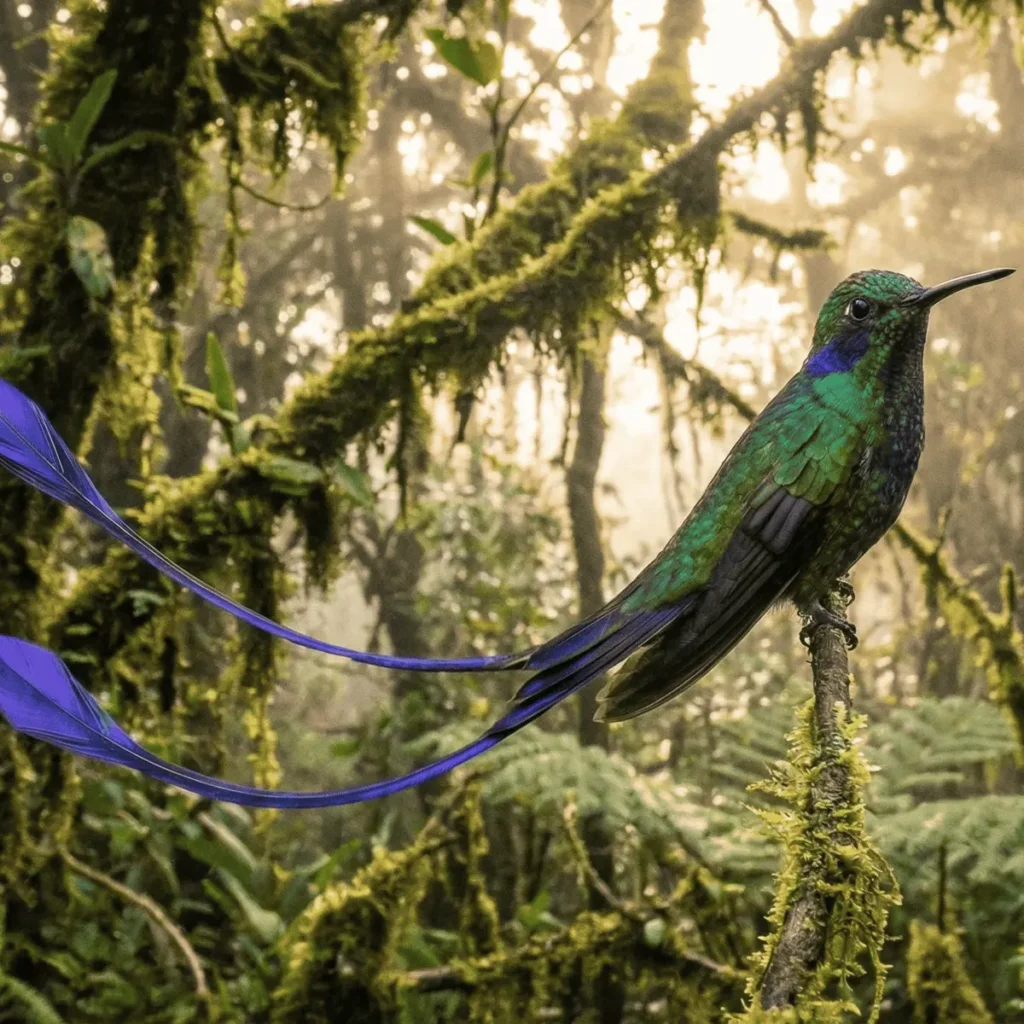
In the northern region of Amazonas, specifically within the Utcubamba River basin, exists a hummingbird that seems to defy the laws of physics. The Marvelous Spatuletail is arguably the most beautiful of all Peruvian birds and is endemic to the country—meaning it lives nowhere else on Earth.
The Geometry of Beauty
The male Spatuletail is the only bird in the world with four tail feathers. The two outer feathers are elongated, wire-like filaments that end in large, violet-blue discs (spatulas). These feathers can move independently. During courtship, the male hovers in front of the female and whips these discs around in a frenzied, hypnotic dance, snapping them together to create a clicking sound.
The energy required for this display is immense. Considering the high metabolic rate of hummingbirds, the Spatuletail is an athlete of the highest caliber. Among the vast catalog of Peruvian birds, this species represents the extreme lengths to which evolution will go to ensure reproduction.
A Restricted Range
The exclusivity of the Marvelous Spatuletail makes it a “Holy Grail” for birdwatchers. However, its range is tiny and fragmented. Deforestation for agriculture has severed the corridors between forest patches. Fortunately, local communities have realized that Peruvian birds attract tourism. Private reserves, such as the Huembo Reserve, have been established where locals plant specific red-flowering bushes that the Spatuletail prefers, ensuring the survival of this glittering jewel of the Andes.
4. Macaws: The Giants of the Amazon (Ara militaris)
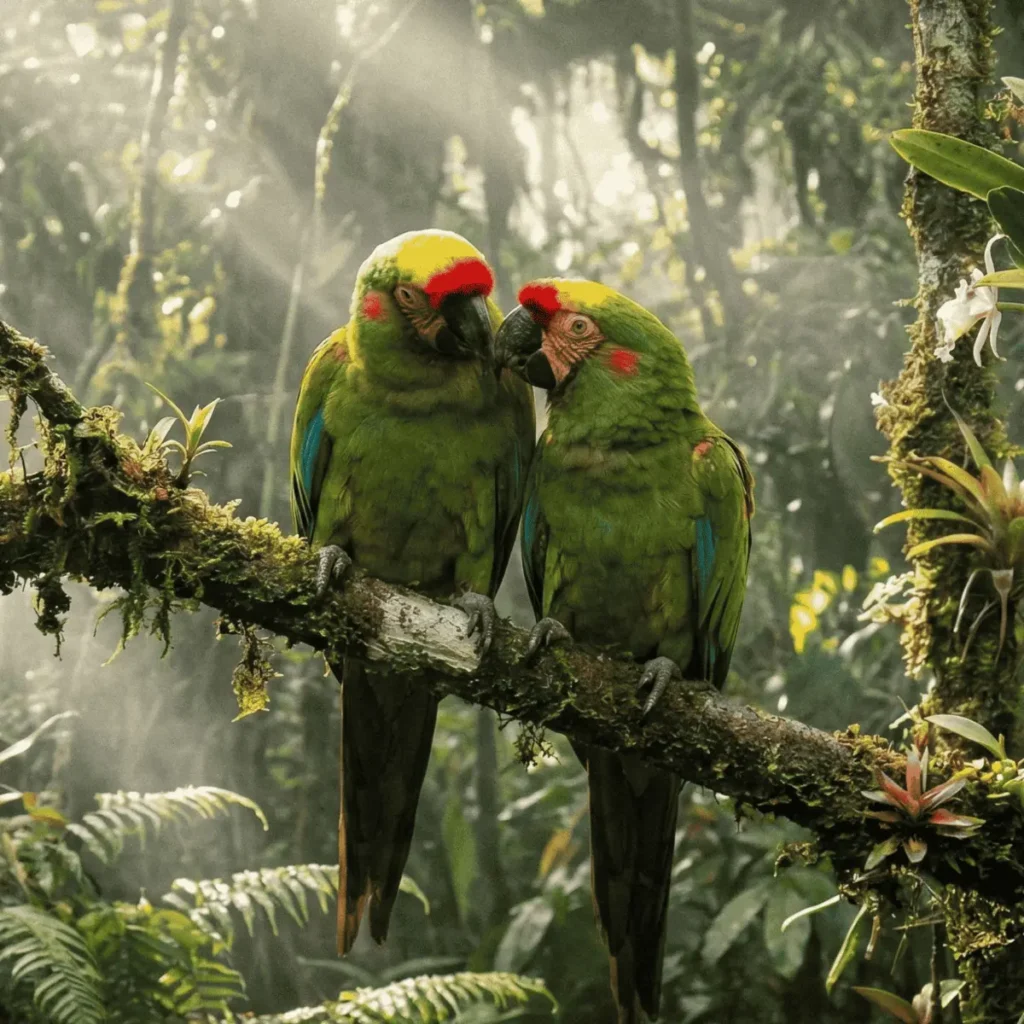
Descending the Andes into the Amazon basin, the palette of nature changes from the grey and green of the mountains to a chaotic explosion of primary colors. Here, the large Macaws—specifically the Red-and-Green Macaw and the Scarlet Macaw—reign supreme. These are the loudest and most colorful of the Peruvian birds.
The Clay Lick Phenomenon
While seeing a Macaw fly over the canopy is impressive, the true spectacle occurs at the “colpas” or clay licks. In the Tambopata National Reserve and Manu National Park, riverbanks expose walls of mineral-rich clay. Every morning, weather permitting, waves of parrots, parakeets, and macaws descend upon these walls.
The sight is deafening and dazzling. Hundreds of Peruvian birds scream, argue, and jockey for position to eat the clay. Scientists believe this clay provides sodium that is lacking in their diet and helps neutralize toxins found in the unripe seeds and fruits they consume. This gathering is one of the world’s greatest wildlife spectacles.
Intelligence and Bonds
Macaws are highly intelligent and social. They mate for life, and it is common to see pairs flying wing-tip to wing-tip, separated only by inches. Their strong beaks can crack the hardest Brazil nuts, a feat few other animals can accomplish. Sadly, their beauty and intelligence make them targets for the illegal pet trade. Protecting the habitat of these Peruvian birds is synonymous with protecting the Amazon rainforest itself.
5. The Andean Flamingo (Phoenicoparrus andinus)

When one imagines flamingos, the mind usually drifts to tropical Caribbean islands. However, Peru hosts three species of flamingos high in the Andes, the most notable being the Andean Flamingo (or Parihuana). These Peruvian birds thrive in environments that would kill most other animals: the high-altitude salt lakes and bofedales (wetlands) above 3,000 meters.
A Symbol of Independence
The Parihuana holds a special place in Peruvian history. Legend dictates that General José de San Martín, the liberator of Peru, was resting on the shores of Paracas when he saw a flock of flamingos taking flight. Their red wings and white chests inspired the colors of the Peruvian flag. Thus, among all Peruvian birds, the flamingo is inextricably linked to the nation’s identity.
Surviving the Altiplano
The environment of the Altiplano is harsh. Solar radiation is intense, oxygen is thin, and nights are freezing. The Andean Flamingo has adapted with specialized filtering mechanisms in its beak to sift microscopic algae and diatoms from the alkaline, brackish waters of the high lakes. Their legs are tough enough to withstand the corrosive nature of the mineral-rich waters.
Visually, they are stunning. Their plumage is a soft pink, with black flight feathers that are visible only when they spread their wings. Seeing thousands of these Peruvian birds mirroring on a glassy lagoon, with the imposing peaks of the Andes in the distance, is a surreal photographer’s dream.
6. The Torrent Duck (Merganetta armata)

Leaving the stagnant lakes for the rushing rivers, we find the Torrent Duck. This species is a specialist, adapted to life in the “whitewater”—the turbulent, fast-flowing rivers that crash down the Andean slopes toward the Amazon and the Pacific. Few Peruvian birds occupy such a physically demanding niche.
Masters of the Current
The Torrent Duck is a marvel of aquatic engineering. It possesses a streamlined body, powerful webbed feet, and a stiff tail that acts as a rudder. Observers are often stunned to see these ducks swimming casually upstream against raging currents that would easily drown a human swimmer. They dive into the foam, searching for stonefly larvae and other aquatic insects clinging to the submerged rocks.
Indicators of Health
The presence of Torrent Ducks is a good sign. They are highly sensitive to pollution and sedimentation. They require crystal-clear, oxygenated water to hunt. Therefore, they serve as bio-indicators; where you find Torrent Ducks, you find a healthy river ecosystem. For trekkers on the Inca Trail or visitors to the Sacred Valley, spotting these Peruvian birds resting on mid-river boulders is a highlight of the journey.
7. The Burrowing Owl (Athene cunicularia)
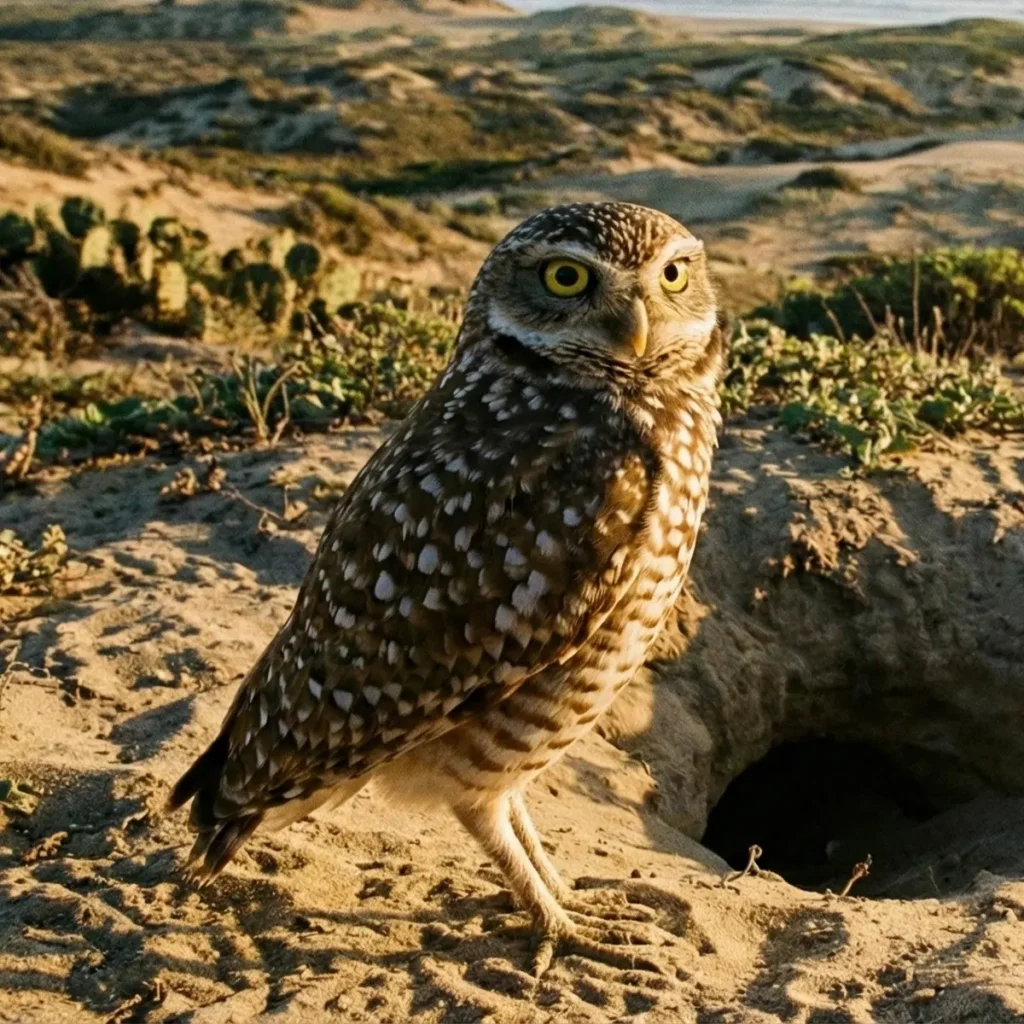
Finally, we return to the coast to meet a bird that has adapted to the arid deserts and the encroaching urban sprawl: the Burrowing Owl, known locally as the Huerequeque. Unlike the mysterious, forest-dwelling owls of legend, this is one of the most visible and charismatic Peruvian birds.
Life Underground
As the name suggests, this owl lives in burrows in the ground. In the soft sands of the coastal desert, they either dig their own tunnels or repurpose those abandoned by mammals. They are crepuscular and diurnal, meaning they are often active during the day.
It is common to see them standing sentinel on mounds of sand or atop the adobe walls of pre-Columbian ruins. With their piercing yellow eyes and long legs, they watch for beetles, small lizards, and mice. When alarmed, they bob up and down in a comical fashion before taking flight.
Urban Resilience
The Burrowing Owl is a testament to resilience. As cities like Lima and Trujillo expand into the desert, the Huerequeque has managed to survive in parks, archaeological sites, and vacant lots. They remind us that Peruvian birds are not just in the remote jungle, but are our neighbors, struggling to adapt to a changing world.
The Importance of Avitourism for Conservation
The seven species described above are merely the tip of the iceberg. The richness of Peruvian birds is a national treasure that requires vigilant protection. The threats are real: illegal mining, deforestation, climate change, and pollution all take a toll on bird populations.
However, there is hope, and it comes in the form of sustainable tourism. Birdwatching, or avitourism, has exploded in popularity. When international travelers visit Peru specifically to see the Spatuletail or the Cock-of-the-rock, they bring economic value to the living forest. Local communities, who might otherwise turn to logging or slash-and-burn agriculture, are learning that a tree is worth more standing (as a home for Peruvian birds) than cut down for timber.
Guides are being trained, lodges are being built with eco-friendly practices, and conservation corridors are being established. The economic chain of birdwatching supports drivers, cooks, boatmen, and local families.
Tips for Observing Peruvian Birds
For those inspired to pack their binoculars and head to South America, here is a practical guide to making the most of your avian adventure.
1. Timing is Everything
While you can see birds year-round, the transition seasons (April-May and September-October) are excellent. The Amazon is best visited during the dry season to access trails, while the coast is great during the Peruvian summer. However, Peruvian birds are early risers. To see the best activity, you must be in the field by 5:30 AM.
2. The Right Gear
You do not need to be a professional photographer. A solid pair of binoculars (8×42 or 10×42 magnification) is the single most important tool. A field guide is also essential. The book Birds of Peru by Schulenberg et al. is considered the bible for identifying Peruvian birds. There are also excellent mobile apps available now that include audio calls.
3. Hire a Local Guide
This cannot be stressed enough. The jungle is dense, and the mountains are vast. A professional birding guide knows the vocalizations—the calls and songs—that reveal a bird’s location long before you see it. They can spot a green parrot against green leaves in a way that seems magical to the untrained eye. Hiring a guide also ensures your money supports the local economy centered around Peruvian birds.
4. Ethical Birding
With the rise of photography, some unethical practices have emerged, such as using “playback” (playing recorded bird songs) excessively to draw birds out. This stresses the animals, distracting them from feeding or nesting. Responsible observation means keeping a respectful distance, staying quiet, and minimizing impact. The welfare of Peruvian birds must always come before the perfect photo.
Conclusion: An Invitation to the Skies
Peru is a country that demands to be explored with all senses. You taste the ceviche, you feel the texture of alpaca wool, you smell the humidity of the jungle. But above all, you must use your eyes and ears to witness the winged life that fills the skies.
The diversity of Peruvian birds is a reflection of the land itself—rugged, colorful, resilient, and beautiful. From the stoic Condor gliding over the deepest canyons to the frenetic hummingbird in the secret valleys of the north, these creatures are the guardians of Peru’s natural heritage.
Whether you are a “lister” trying to reach 500 species in a week, or a casual traveler who simply appreciates the flash of color in the trees, Peru welcomes you. The sheer abundance of life here changes the way you look at the world. It reminds us of the complexity of nature and our responsibility to preserve it.
So, grab your binoculars and look up. The Peruvian birds are waiting to tell you their story, one feather at a time.
BLOG HOME